

Commercial roof flashing inspections and repairs at curbs, walls, penetrations and roof edges for Bellevue commercial property teams.
A leak near a wall, curb or equipment base can point to failed flashing, but the visible interior mark does not identify the exact roof transition. We inspect the reported area and nearby details, looking for separated material, open laps, loose terminations or conditions that may have existed before the water appeared. The scope records what is visible, what can be repaired and whether a test is needed to assess concealed moisture. Each photo is tied to a roof zone so the building team can review the same location. Cool-season rain in Bellevue can expose weaknesses at roof openings and perimeter transitions. A commercial property in Wilburton or the wooded Bridle Trails area still requires building-specific access and roof evaluation. We confirm the facility contact and inspection route, including escort and roof-access details, before planning commercial roof repair. | 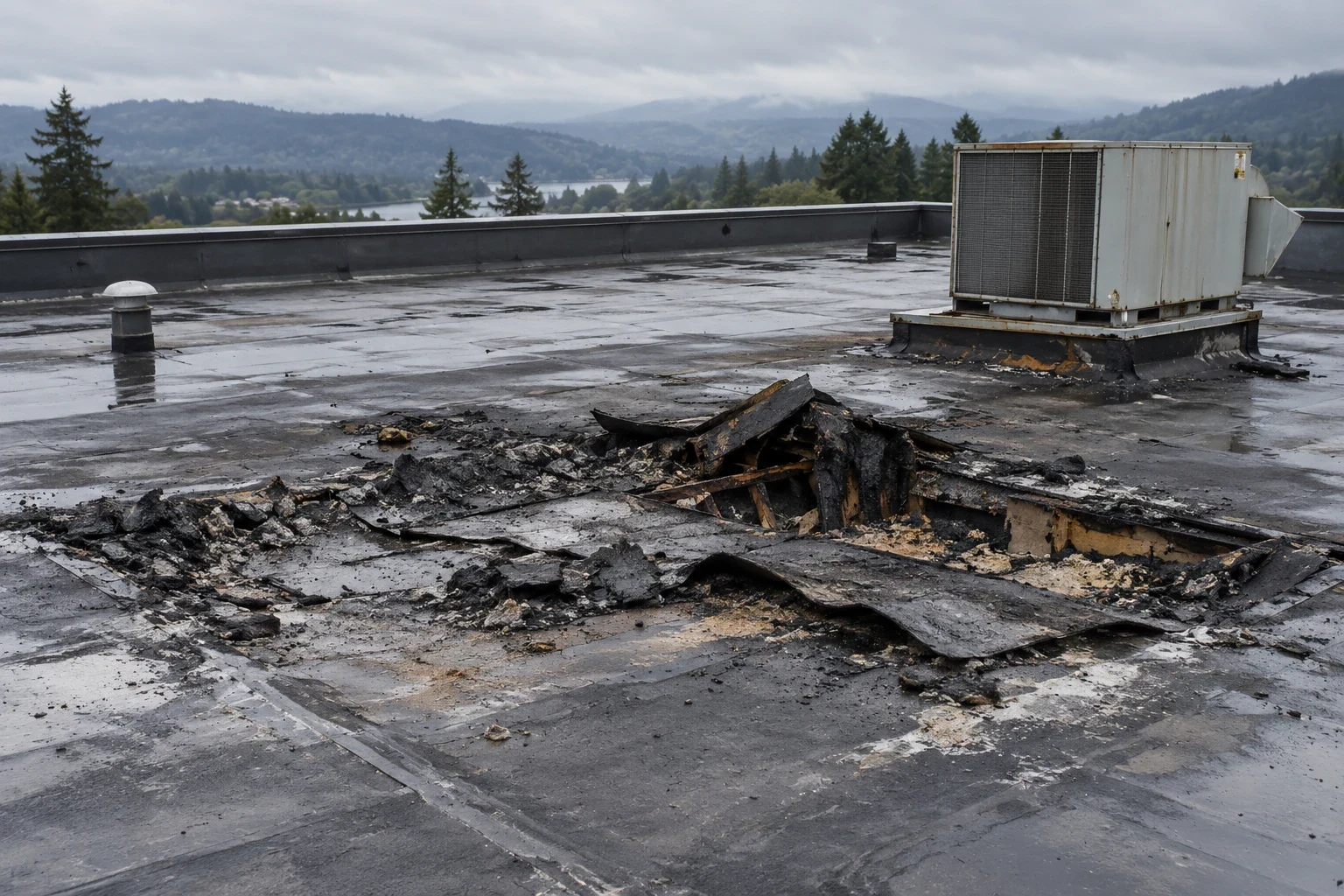 |
Follow Water to the Roof Transition
We ask which room or ceiling area showed water, when it appeared and whether the report recurred. On the roof, we trace likely paths to vertical walls, parapets, curbs, pipes, vents, skylights and equipment supports. Flashing may be hidden below a cover or interrupted by a later installation, so the inspection notes what could be viewed without removing material. A condition that is not visible is described as unverified rather than assumed to be sound.
Water can move laterally through a roof assembly before it shows indoors. We compare the reported location with drainage direction, seams and roof penetrations and photograph evidence along the route. If the probable transition is still unclear, a test opening may be proposed with a defined size and restoration method. The owner decides whether that additional step is appropriate. A more complete review can also note any adjacent membrane damage that affects the repair boundary.
Identify Why the Flashing No Longer Holds
Flashing failure can involve a split or lifted membrane, a loose termination bar, aged sealant, a damaged counterflashing edge or movement at an equipment curb. We describe the specific detail rather than label the entire roof as failed. The inspection considers whether the adjacent membrane is secure and whether water is entering at one point or along a longer transition. If another trade installed or maintains the equipment, the facility contact can help confirm the curb and service history.
A roof repair must connect the new flashing to material that can hold the detail. If the surrounding membrane is brittle, wet or detached, the work area may need to expand beyond the visible opening. We identify that possibility before cutting or removing the assembly. Where the problem is actually an open field seam, the owner may need a seam failure inspection rather than a curb-only repair.
Restore the Transition With a Compatible Detail
The repair scope identifies the substrate, flashing material, attachment, seal and tie-in required for the roof type. We prepare the surface, remove material that cannot support the connection and install a compatible detail at the affected transition. The finished work is checked for secure edges, continuous laps and a clean termination. Photos show the repaired location and surrounding condition so later inspections can identify what was changed. When the affected detail crosses dissimilar materials, the scope names the boundary and how the tie-in is protected. We check that the finished edge sheds water toward the roof drainage path and does not leave exposed material at a termination. If a test opening or removal reveals a different substrate than expected, the work pauses for owner review before the repair limits change.
Metal counterflashing or edge components may need to be refastened or replaced when movement has opened the water path. If the scope requires replacement, we identify which length or section is involved and where it meets adjacent roof work. Wind-related roof repairs may address displaced perimeter material, while a flashing scope focuses on the transition and its tie-in. We keep the recommendations distinct when the inspection finds both conditions.
Coordinate Equipment and Occupant Access
Before roof entry, the property contact confirms keys, escort rules, fall-protection requirements, parking and any rooms below the proposed repair. A flashing inspection beside rooftop equipment may need a mechanical contact to confirm whether a unit can be accessed or moved. Roofing staff do not operate HVAC, electrical or other building systems. The authorized technician controls that work and approves any required shutdown. We note if inspection must be split into a roofing visit and a later equipment-access appointment.
Bridle Trails lies between SR 520, I-405, the Bellevue boundary and 148th Avenue NE, while Wilburton is a redevelopment area with office, medical, retail and hotel uses. Those local settings may affect arrival or tenant coordination, but each owner sets the access plan. A Wilburton roof inspection begins with the confirmed site route and contact. If work is above a tenant area, staff can establish a notice window and interior protection before the crew starts.
Document the Repair and Any Remaining Questions
Closeout describes the failed detail, repair performed, adjacent material reviewed and any limitation that remains. Photos show the original issue when available and the completed connection. If testing found moisture below the flashing, the record states where it was checked and how the opening was restored. If the repair could not be completed because the unit or wall area was inaccessible, that constraint is included with the recommended follow-up.
A roof condition report can record separate conditions on other roof sections. If the defect is part of a larger aging assembly, replacement planning can define the areas for further evaluation. Send the building address, reported room, earlier repair history and roof plan if available. We will document the transition and set out what is established, what was repaired and what needs another decision.
Commercial Roofing Questions
What roof locations commonly need flashing review?
We inspect transitions at walls, curbs, pipes, vents, skylights, parapets and equipment supports when they relate to the reported condition. The actual repair area depends on what the roof inspection shows.
Can you repair flashing around rooftop equipment?
We can inspect and repair roof-side flashing when access and equipment coordination are approved. A facility technician remains responsible for operating or moving the unit.
How do you know if flashing caused the leak?
We document the visible transition and compare it with the interior report and nearby roof details. If the evidence does not confirm the path, we identify the additional inspection or test that may help.
Does failed flashing mean the whole roof needs replacement?
Not by itself. We define whether the defect is limited or connected to broader membrane, substrate or drainage concerns before discussing a wider scope.
What should we provide before a flashing inspection?
Share the address, affected room or roof area, dates water appeared, prior repairs and any access or equipment restrictions. A roof plan can help pinpoint the transition.